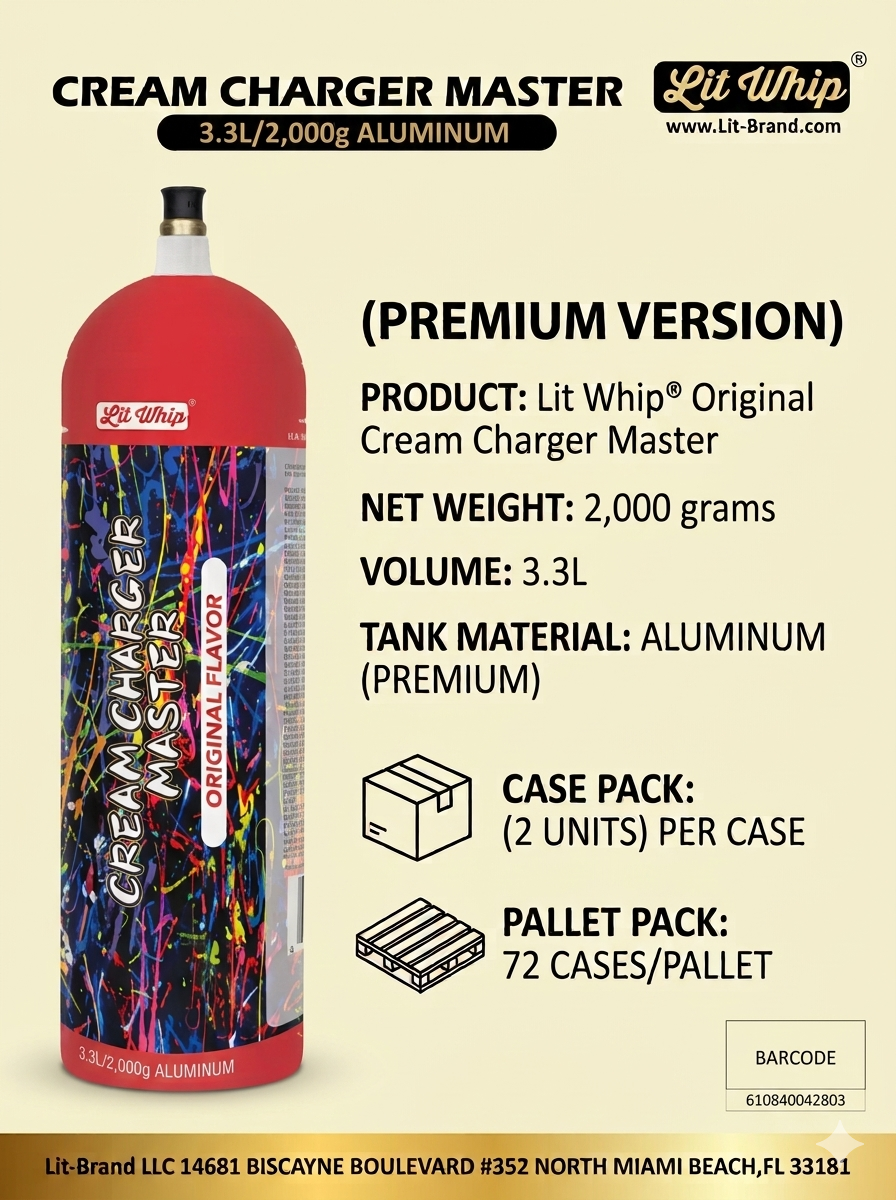
A detailed guide to Lit Whip Original steel tanks: compare the 1L, 3.3L, and 4.5L SKUs, case packs, pallet quantities, receiving, and replenishment.

A dependable wholesale order starts long before a shipment arrives. Buyers need clear product records, a realistic receiving plan, and replenishment decisions based on actual demand—not just a product name on a purchase order. The Lit Whip® Cream Master Tank — Original steel lineup gives commercial buyers three distinct formats to compare: 1L / 680G, 3.3L / 2,000G, and 4.5L / 3,000G.
This resource is designed for retailers, resellers, distributors, and commercial purchasing teams. It brings together the key details for each featured steel-tank SKU, then walks through the practical work behind a successful order: specifying products, planning storage, counting deliveries, keeping inventory records accurate, and communicating responsibly with staff and customers.
The Lit Whip Original steel tank lineup at a glance
The three steel tank formats are related products, but they are not interchangeable. Each has a different capacity, SKU, case configuration, and pallet quantity. Keeping those distinctions visible in every purchasing and warehouse document helps prevent costly mix-ups.
| Format | SKU | Pack configuration | Pallet configuration |
|---|---|---|---|
| 1L / 680G Steel Original | 610840042797 | 6 units per case | 78 cases per pallet |
| 3.3L / 2,000G Steel Original | 610840042094 | 2 units per case | 84 cases per pallet |
| 4.5L / 3,000G Steel Original | 610840042117 | 1 unit per case | 128 cases per pallet |
Use this table as a purchasing reference, then confirm current availability and any live order requirements through the wholesale catalog before placing an order.
A closer look at each featured SKU
1L / 680G steel tank — SKU 610840042797
The Lit Whip Cream Master Tank — Original 1L / 680G Steel format is packed six units per case, with 78 cases per pallet. The six-unit case format gives buyers a straightforward way to build smaller replenishment orders while still maintaining a consistent product record.
For a buyer adding this SKU to an existing assortment, the most useful first step is to define how the item will be counted. Will your team count by individual units, by sealed cases, or both? Decide that before the first delivery and make the answer visible on the product record. A clear unit of measure keeps purchasing, receiving, and sales reporting aligned.
Recommended item description:
Lit Whip® Cream Master Tank — Original Steel, 1L / 680G, SKU 610840042797, 6 units per case.
3.3L / 2,000G steel tank — SKU 610840042094
The Lit Whip Cream Master Tank — Original 3.3L / 2,000G Steel format is packed two units per case, with 84 cases per pallet. Because the product is sold in a two-unit case configuration, warehouse teams should be able to see at a glance whether stock records are tracking individual units or full cases.
This is also the point where precise naming matters. Do not rely on a shortened general description such as “Lit Whip 3L.” Use the approved size, material, and SKU: 3.3L / 2,000G Steel Original, 610840042094. Clear naming helps distinguish this product from other Lit Whip formats and makes purchase-order review faster.
Recommended item description:
Lit Whip® Cream Master Tank — Original Steel, 3.3L / 2,000G, SKU 610840042094, 2 units per case.
4.5L / 3,000G steel tank — SKU 610840042117
The Lit Whip Cream Master Tank — Original 4.5L / 3,000G Steel format is packed one unit per case, with 128 cases per pallet. With a one-unit-per-case configuration, each carton is also one inventory unit. That can simplify individual-unit counting, but it makes carton accuracy especially important during receiving and storage.
For this format, give the warehouse team a designated location and a product label that includes both the SKU and capacity. A large-format product should never be identified only by a brand name or a handwritten abbreviation. The goal is simple: a team member should be able to verify the item without having to guess.
Recommended item description:
Lit Whip® Cream Master Tank — Original Steel, 4.5L / 3,000G, SKU 610840042117, 1 unit per case.
Why product records matter in wholesale buying
A strong product record supports every department that touches the order. Purchasing needs it to place the right order. The warehouse needs it to receive and store the right product. Accounting needs it to reconcile invoices. Sales and customer-service teams need it to communicate accurate information.
For each SKU, maintain a record that includes:
- Full product name, including Original and Steel.
- SKU and barcode information where available.
- Capacity and quantity description.
- Units per case and cases per pallet.
- Your internal unit of measure for purchasing and inventory.
- Primary storage location and replenishment location.
- Current supplier documentation and manufacturer handling guidance.
Avoid combining the three sizes under one generic “Lit Whip tank” line item. A shared name may look convenient, but it creates ambiguity when a buyer needs to compare case quantities, when a receiver checks a shipment, or when an operations manager reviews inventory.
Turn the product facts into a purchase-order checklist
Before a purchase order is submitted, review more than price and quantity. A complete order document reduces back-and-forth later and creates a usable trail for your team.
Confirm the product identity
Match the requested item against the SKU—not just the product family name. For example, confirm that a request for the 3.3L / 2,000G steel tank specifies 610840042094 and not another 3.3L format.
Confirm the order quantity in the right unit
Make it clear whether the requested quantity means units, cases, or pallets. A note such as “10” is incomplete without a unit of measure. Write “10 cases” or “10 pallets” so every person reviewing the order interprets it the same way.
Confirm the receiving destination
Verify the delivery address, contact name, receiving hours, dock access, and any appointment requirements. For a larger shipment, identify who has authority to accept the delivery and who will record exceptions.
Confirm the storage plan
Know where the product will go before it arrives. Assign a location, make sure labels are ready, and confirm that your organization’s storage procedures and manufacturer guidance are available to the team.
Make receiving day more reliable
Receiving is where an accurate order becomes accurate inventory. Give the receiving team a copy of the purchase order or an itemized receiving sheet with the SKU, full product description, expected carton count, and unit-of-measure details.
A practical receiving routine can follow five steps:
- Match the shipment to the order. Verify the supplier and purchase-order reference before unloading or accepting the delivery.
- Verify the SKU and description. Read the product label and compare it with the expected SKU, capacity, and steel-tank description.
- Count cases and units. For six-unit and two-unit cases, record both case count and unit count when your inventory system requires it. For the 4.5L format, remember that one case equals one unit.
- Inspect packaging. Look for visible damage, moisture, crushed cartons, or other delivery concerns. Follow your organization’s process for recording exceptions.
- Update inventory promptly. Move accepted goods to the assigned location and update the inventory record as soon as the count is verified.
A simple habit—recording the receiver’s initials and the delivery date on the receiving sheet—can make later inventory research far easier.
Plan storage and replenishment with the full pallet picture
Pallet quantities are planning inputs, not automatic reorder targets. The 1L format lists 78 cases per pallet, the 3.3L format lists 84 cases per pallet, and the 4.5L format lists 128 cases per pallet. Those figures help you estimate receiving volume, floor space, storage locations, and the time needed to count an inbound shipment.
Start with your own sales data and operating capacity:
- How many units or cases does your business move in a typical week or month?
- How much usable, compliant storage space is available after receiving?
- How often can your team safely and accurately receive shipments?
- What is the reorder point that protects availability without creating excess inventory?
- Who is responsible for checking on-hand quantities before a new order is placed?
For new products, a case-level order may provide useful demand information before considering larger-volume purchasing. For established demand, use sales velocity, storage capacity, delivery lead time, and inventory carrying needs to determine the right cadence. The best replenishment plan is documented, reviewable, and based on your business—not a one-size-fits-all number.
Create a clear warehouse labeling system
Warehouse labels should help a team member make the correct decision quickly. Include the full product name, SKU, size, case pack, and a scannable inventory identifier when your operation uses one.
Examples:
- LW Steel 1L / 680G | SKU 610840042797 | 6/Case
- LW Steel 3.3L / 2,000G | SKU 610840042094 | 2/Case
- LW Steel 4.5L / 3,000G | SKU 610840042117 | 1/Case
Keep product labels, receiving sheets, and inventory-system descriptions consistent. If your warehouse says “3.3L Steel,” but purchasing uses “3L Original,” staff may not know whether they refer to the same item. Consistency is one of the simplest ways to prevent avoidable errors.
Help sales teams communicate with accuracy
A wholesale sales conversation should be informative without overpromising. Equip sales and customer-service teams with the confirmed product facts: material, capacity, SKU, pack configuration, and current catalog destination. When buyers ask about availability, delivery timing, handling, or product specifications beyond the published record, direct the question to the current catalog details and manufacturer documentation.
Do not make unsupported performance, handling, or use claims. Follow manufacturer labels, applicable laws, and your organization’s policies. Responsible communication protects customers and helps preserve the credibility of your wholesale program.
A repeatable review before every reorder
Before reordering any of the three Lit Whip Original steel formats, pause for a short review:
- Check on-hand stock and open purchase orders.
- Review recent sales velocity by SKU.
- Verify that the reorder quantity is stated in units, cases, or pallets.
- Confirm the SKU, capacity, steel material, and case pack.
- Confirm storage space and the receiving plan.
- Recheck current wholesale availability and ordering details.
This routine takes only a few minutes, but it connects the purchasing decision to real inventory conditions. Over time, the record becomes more valuable: you can see what moves, how often you replenish, and where process improvements will have the most impact.
Next step for wholesale buyers
For current wholesale availability and purchasing details, review the Lit Whip Cream Master Tanks catalog listing. ALL ABOUT IT LLC can help commercial buyers organize a documented purchasing and inventory plan built around the appropriate Lit Whip steel-tank SKU.
Explore Topics
Written by
All About It LLC Team
Content creator and writer sharing insights and stories.