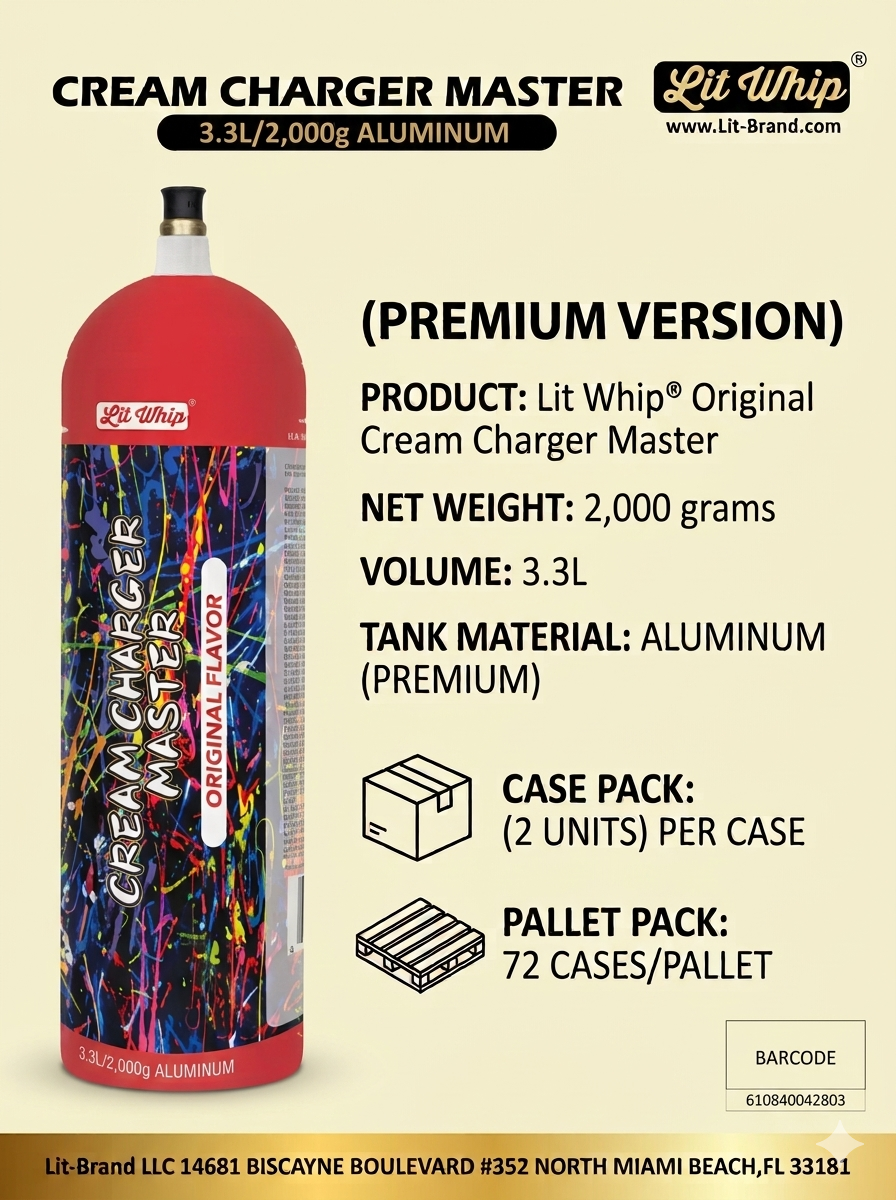
Plan wholesale orders for the Lit Whip Original 9L / 6,000G steel tank with SKU, master-case, pallet, receiving, and inventory guidance.

When a new large-format item is added to a wholesale assortment, a dependable process matters as much as a clear product listing. The Lit Whip® Cream Master Tank — Original Steel, 9L / 6,000G should have a consistent record across purchasing, receiving, storage, and fulfillment so every team works from the same facts.
This buyer guide is for commercial purchasing teams planning around the 9L / 6,000G Original steel tank. It covers the approved SKU, master-case and pallet configuration, purchase-order clarity, receiving checks, warehouse labeling, and inventory controls that help make larger inbound orders easier to manage.
Confirm the approved product record
Use the following product record wherever the item appears in your business systems:
Lit Whip® Cream Master Tank — Original Steel, 9L / 6,000G
SKU: 610840042131
Configuration: 1 unit per master case
Pallet configuration: 72 units per pallet
The 9L / 6,000G capacity, Original designation, steel construction, and SKU are all part of the product identity. Include each element on purchase orders, receiving documents, warehouse labels, inventory records, and sales references. A generic label such as “Lit Whip large tank” can create unnecessary uncertainty when multiple sizes are stocked.
A useful standardized description is:
Lit Whip® Cream Master Tank — Original Steel, 9L / 6,000G, SKU 610840042131, 1 unit per master case, 72 units per pallet.
Set the purchase order up for success
A clear purchase order gives the receiving team a dependable point of comparison when the shipment arrives. The line item should name the product, include SKU 610840042131, and state the ordered quantity with the unit of measure spelled out.
Because this product is configured as one unit per master case, case and individual-unit counts are equivalent for ordinary receiving reconciliation. For example, an order for 12 master cases represents 12 units. A full pallet represents 72 units. Still, write “master cases” or “units” clearly instead of using an unexplained quantity alone.
Before issuing the order, review:
- Verified demand and recent movement for this specific SKU.
- On-hand quantity, allocated inventory, and confirmed inbound stock.
- Available floor space and the designated storage location.
- Delivery appointment, access, and equipment requirements for the shipment.
- Your company’s established reorder point and lead-time expectations.
- Current manufacturer documentation and applicable internal procedures.
Pallet capacity helps logistics planning; it is not an automatic reorder quantity. The right order quantity is the amount that aligns with your verified sales, storage capacity, and operational plan.
Prepare the receiving team before delivery
Send the receiving team an itemized advance notice that includes the purchase-order number, product name, SKU, expected master-case quantity, and expected unit quantity. When the delivery arrives, the team should use the same detailed description that purchasing used.
A practical receiving sequence is:
- Match the shipment to the purchase order. Verify the supplier, reference number, and delivery paperwork.
- Confirm product identity. Check that labels identify the Original steel 9L / 6,000G format and SKU 610840042131.
- Count master cases. Compare the physical case count against the expected order quantity.
- Reconcile unit quantity. With one unit per master case, the accepted case count and unit count should match.
- Inspect exterior packaging. Record visible delivery exceptions through your established facility procedure.
- Post the receipt promptly. Update the inventory system once the quantity and condition review is complete.
Document the date, receiver, accepted quantity, and any discrepancy. A straightforward receiving record makes later inventory research much faster and gives purchasing a factual basis for supplier follow-up when needed.
Use clear warehouse labels and locations
Assign the product a defined storage and pick location based on manufacturer guidance, facility procedures, and applicable requirements. The physical label should be detailed enough for a team member to identify the exact item without relying on memory.
A warehouse label can read:
Lit Whip Original Steel 9L / 6,000G
SKU 610840042131 | 1 unit per master case
Keep the wording aligned with the product record in your purchasing and inventory systems. If one team uses “9L Original” while another uses a different shorthand, it becomes harder to confirm whether both records refer to the same SKU.
Separate similar formats wherever practical, and use location identifiers on both the shelf or floor position and in the inventory system. Consistent location control supports accurate cycle counts, replenishment, and order picking.
Build routine inventory checks into the workflow
A recurring count process is more reliable than a visual estimate. Compare physical inventory to system records on a schedule that fits the item’s movement and your operational needs. Investigate discrepancies promptly, including misplaced product, incomplete receiving entries, allocation errors, or unrecorded adjustments.
During each review, ask:
- Does the system count match the physical master-case count?
- Are pending customer commitments separated from available inventory?
- Is any inbound quantity already expected or allocated?
- Does the product record still use SKU 610840042131 and the full 9L / 6,000G description?
- Is the storage location safe, organized, and clearly labeled?
- Does the reorder decision reflect confirmed demand instead of assumptions?
These checks create a repeatable control that any trained team member can follow. They also help protect the accuracy of catalog availability information provided to commercial customers.
Communicate with buyers using confirmed facts
When quoting or listing this product, keep messaging limited to verified details: Original steel construction, 9L / 6,000G capacity, SKU 610840042131, one unit per master case, and 72 units per pallet. For handling direction, technical specifications beyond the approved record, or intended-use questions, refer commercial buyers to current manufacturer documentation and applicable requirements.
Avoid making unverified product, performance, handling, or use claims. Accurate catalog records and responsible communication support a dependable wholesale relationship and help buyers make informed purchasing decisions.
Wholesale checklist for the 9L / 6,000G tank
Before placing or receiving an order, confirm:
- Product: Lit Whip® Cream Master Tank — Original Steel.
- Capacity: 9L / 6,000G.
- SKU: 610840042131.
- Configuration: 1 unit per master case.
- Pallet configuration: 72 units per pallet.
- Purchase orders clearly state the unit of measure.
- Receiving, storage, and inventory records use the same product description.
- Current manufacturer documentation and internal procedures are available to the team.
Next step for commercial buyers
Visit the Lit Whip Cream Master Tanks catalog listing for current wholesale availability and purchasing details. ALL ABOUT IT LLC can help commercial buyers maintain a clear, documented sourcing and inventory process around the appropriate Lit Whip SKU.
Explore Topics
Written by
All About It LLC Team
Content creator and writer sharing insights and stories.